Are BS6 Buses More Fire-Prone? Causes, Expert Insights, and Safety Analysis

Are BS6 buses more prone to bus fires? Recent incidents suggest they can catch fire more frequently due to high engine temperatures and DPF regeneration processes. We spoke to industry veterans who shared their views on electrical system risks and the importance of thermal management in preventing fire hazards in modern BS6 buses.
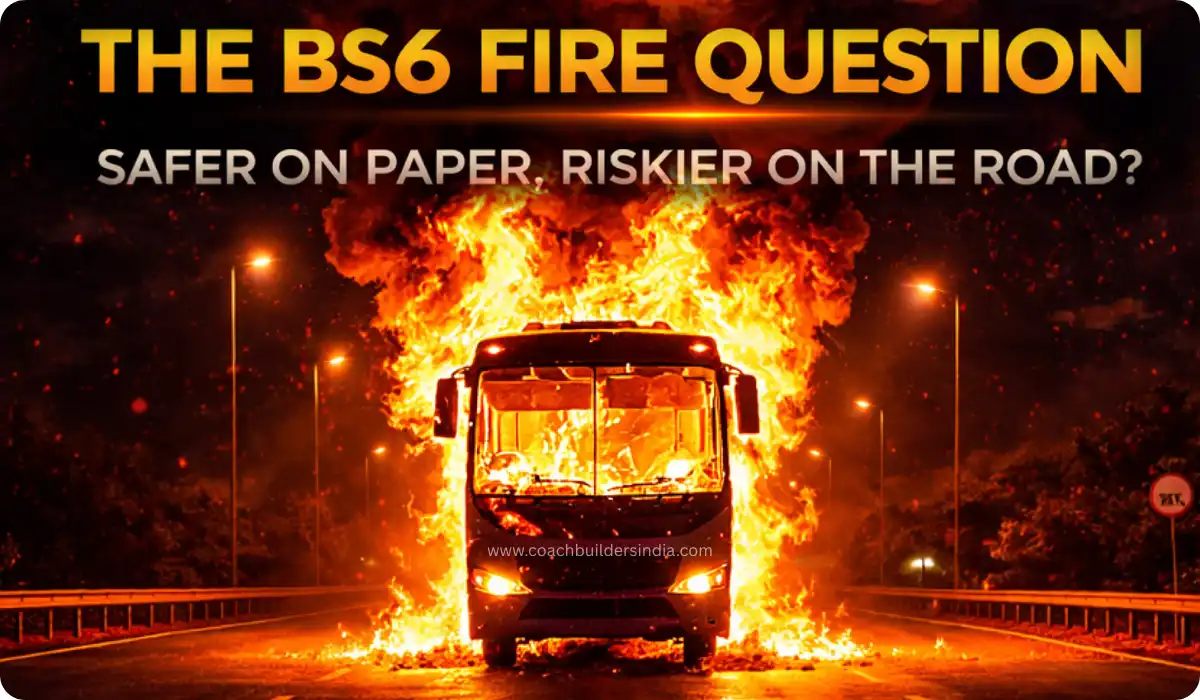
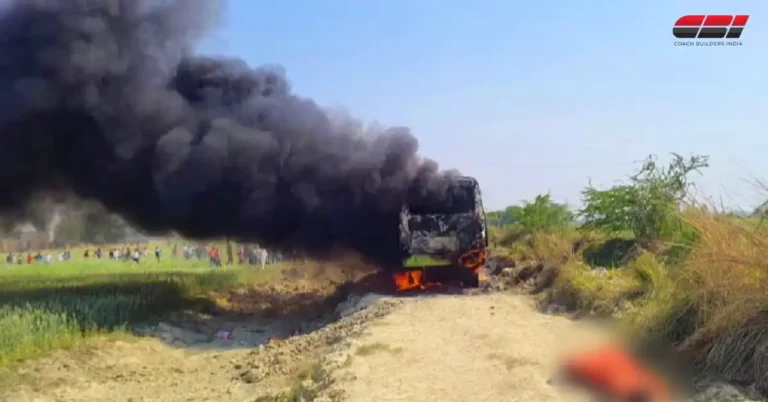
Over the past months, a pattern has begun to draw attention across India’s bus industry. Several fire incidents that made national headlines involved BS6 buses.
What started as a quiet discussion has now evolved into a serious technical question – is BS6 inherently more vulnerable to fire risk, or is the ecosystem still adapting to a far more complex generation of machines?
The transition from BS4 to BS6 engines marked one of the biggest technological shifts in India’s bus industry. To meet stricter emission norms, manufacturers introduced advanced after-treatment systems, increased fuel injection pressures, and denser networks of sensors and wiring.
While these innovations reduce emissions and improve efficiency, they also create a thermally intense and maintenance-sensitive environment, which experts say can increase the likelihood of bus fires if not properly managed.
Industry stakeholders, including bus body builders, fleet operators, and OEM representatives, agree that the concentration of recent fire incidents in BS6 buses cannot be dismissed as a coincidence.
“BS6 buses are not inherently unsafe, but the technology introduces new engineering challenges. Operators, body builders, and OEMs must work together to improve integration, thermal management, and field-level preparedness to reduce fire risk,”
Shivakumar V, President, Strategy & Sales at MG Group
Why BS6 Buses May Be More Fire-Prone
“It is a fact that a large proportion of reported fire incidents involve BS6 vehicles, though this has not been adequately analysed or discussed in the public domain,” said Sivakumar V, President, Strategy & Sales at MG Group.
According to him, BS6 technology introduced a set of engineering shifts that significantly altered the operating environment of buses.
- Higher exhaust temperatures
- DPF regeneration cycles
- Tighter packaging constraints
- Complex electrical and electronic systems
“These factors demand a much higher level of integration, validation, and operating discipline,” he explains.
“My suggestion is that we focus on why fires occur in the first place, so they don’t start at all. Current technologies, like FDSS, act only after a fire has begun – the emphasis must shift to prevention.”
Najrudin Mujawar, Owner and Head of Marketing, Sahara Coach
Higher Operating Temperatures in BS6 Engines
Shiva Narayan Sharma, Director, Sanatan Bus Body Builders Pvt. Ltd., echoes similar thoughts about the higher operating temperatures of BS6 engines that can potentially contribute to bus fires.
“Due to higher exhaust gas temperatures and after-treatment regeneration cycles, under-hood heat loads are substantially elevated. This increases thermal stress on wiring harnesses and associated electrical systems, accelerating insulation ageing and raising the probability of short-circuit events,” he notes.
Suresh Selvaraj, Director, Swamy Ayyappa Travels, points out that this heat affects other critical systems like radiators.
“Due to high temperatures, radiators frequently develop small leaks or require replacement because they cannot withstand sustained heat. This shows that the additional heat generated by BS6 engines is a key factor behind component stress and, potentially, fire risks,” he explains.
He adds that heat management is critical to safety. “When heat-related component failures occur, they can trigger fires. Even collisions are more hazardous, as the thermal stress in these vehicles makes them more prone to ignition,” Selvaraj notes.
“When you compare BS4 and BS6 engines, the difference in operating temperatures is significant. BS6 engines run considerably hotter. At these elevated temperatures, wiring harnesses are subjected to much greater thermal stress, increasing the risk of insulation degradation and potential short circuits.”
Shiva Narayan Sharma, Director, Sanatan Bus Body Builders Pvt. Ltd.
DPF Regeneration and Fire Risks in BS6 Engines
%20(1).webp "Are BS6 Buses More Fire-Prone? Causes, Expert Insights, and Safety Analysis")
Beyond baseline engine temperatures, stakeholders have highlighted diesel particulate filter (DPF) regeneration cycles as a significant source of localised heat, sometimes reaching 600–700°C.
“The DPF regeneration process generates extreme localised heat to burn accumulated soot, far hotter than BS4 exhausts,” explains Sunny Tomar, Director, Sagar Tourist Bus.
“This intense heat can pose a fire risk if nearby components, such as fuel or hydraulic lines, are not properly shielded, as it may lead to leaks or failures that could ignite.”
Yash Sharma, Director, Damodar Group, cautions that the risk increases significantly when the exhaust or DPF system becomes heavily choked.
“During active regeneration, DPF temperatures typically range between 600–700°C, and in severe or abnormal conditions can approach 1,000°C. Such extreme thermal loads can become a critical factor in fire incidents,” he explains.
“A key design change is the fuel tank: while BS4 tanks were metal, many BS6 tanks use materials more prone to leakage. With the silencer located nearby, any leak can quickly ignite, significantly increasing fire risk.”
Yash Sharma, Director, Damodar Group
He further notes that while these systems are engineered to withstand high temperatures, danger arises if overheating leads to exposure of nearby diesel lines, plastic components, insulation materials, or AdBlue and fuel tanks.
At elevated temperatures, polymers can soften or melt rapidly, potentially creating conditions conducive to ignition if fuel or combustible materials are present.
Impact of Tighter Packaging on Heat Retention and Fire Potential
Multiple stakeholders observed that compared to BS4 platforms, BS6 engines are far more tightly packaged and this density creates a heat retention effect.
“The engine area is tightly packed now,” says Najrudin Mujawar, Owner and Head of Marketing, Sahara Coach. “What used to be relatively open space for airflow is now occupied by additional systems. Heat dissipation is not what it used to be.”
Some builders also pointed to layout changes around fuel systems. Compared to earlier BS4 platforms, certain BS6 configurations place high-temperature exhaust components closer to fuel tanks and lines. In the event of a collision or even a minor leak, the proximity of high heat and pressurised fuel increases ignition risk, they argue.
“DPF regeneration produces extremely high localized temperatures to burn soot, far exceeding BS4 exhausts. If nearby components like fuel or hydraulic lines aren’t properly shielded, this intense heat can trigger leaks or failures, creating a real fire risk.”
Sunny Tomar, Director, Sagar Tourist Bus.
Electrical Complexity and Overheating Concerns in BS6 Buses
If heat was the first concern, electrical complexity was the second and most consistently emphasised.
BS6 buses carry a far denser network of sensors, control units, emission modules, and wiring harnesses than BS4 models, each adding circuits and feedback loops. Builders also note that complexity extends to the body: modern sleeper buses can have hundreds of LED lights, charging points, entertainment systems, and inverter-based power supplies, all significantly increasing the electrical load.
According to Yash Sharma, even a single LED destination board contains thousands of diodes. “Sleeper buses can have 200 to 300 internal lights plus charging points. If wiring capacity is not aligned with the load, overheating becomes a risk.”
Aftermarket modifications often exacerbate these risks. Most aftermarket electricians are not trained on BS6 systems, and inconsistent wiring practices can increase circuit loads, create localised overheating, and compromise overall system reliability.
Inadequate technician training and ad hoc modifications, therefore, raise the probability of electrical faults and operational failures.
“BS6 engines have struggled on Indian roads. Fuel efficiency is poor, electrical issues persist without immediate solutions, and repeat breakdowns are common. Operators are facing significant challenges, and many feel these vehicles do not deliver value for money.”
Suresh Selvaraj, Director, Swamy Ayyappa Travels
BS6 Buses Require a New Approach to Safety
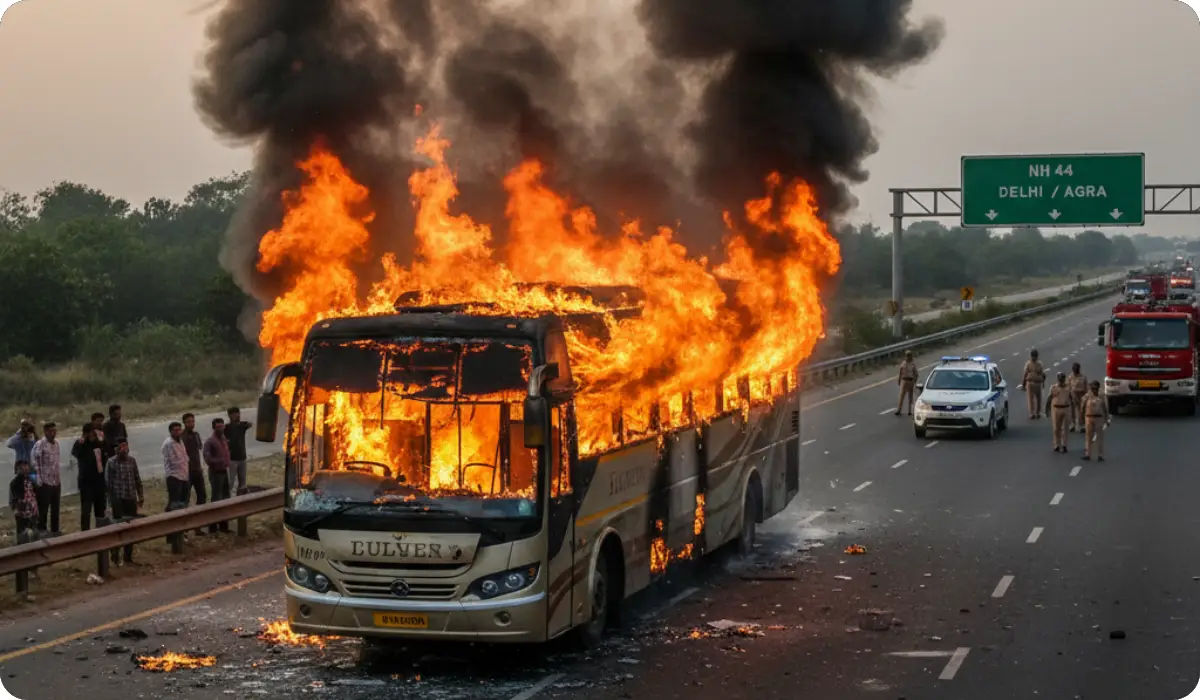
Experts agree that the prevalence of fire incidents in BS6 buses can no longer be dismissed as a coincidence. While no single factor alone explains the phenomenon, BS6 technology introduces several engineering challenges (as explained above) that may contribute to BS6 buses catching fire frequently.
“These factors demand a higher level of integration, validation, and operating discipline,” says Shivakumar V. He further explains that to prevent frequent bus fire accidents, BS6 buses require:
- Enhanced thermal shielding
- Rerouted wiring and fuel lines
- Improved heat management strategies
- Better driver training on regeneration behaviour.
“The industry is still in a learning and stabilisation phase, and OEMs and bus body builders must work collectively to improve practices,” he adds.
“My suggestion is that we should work on why the fire happens in the first place so that it doesn’t catch fire at all. All the technology we are adding now, like FDSS, only acts after a fire has started. The focus must shift to prevention,” adds Najrudin Mujawar.
Shivakumar V further stresses the need for a comprehensive and technically robust investigation into the recent bus fire incidents in India.
“This should examine body–chassis integration practices, compliance with bus body code specifications, chassis and engine design, including BS6 after-treatment systems, thermal management, electrical architecture and wiring protection, material flammability, interior layouts, operating conditions, duty cycles, maintenance practices, and driver awareness alongside early-warning systems,” he emphasises.
Yash Sharma emphasises that safety is a shared responsibility and the entire ecosystem should collaborate — from OEMs to bodybuilders and operators — to ensure robust design, proper integration, and preventive practices.
“OEMs must rethink engine layouts and the integrity of wiring systems. Too often, blame is shifted to bus body builders, but the root issues may lie in the original chassis and engine design.”
Taken together, these observations underline a simple truth – BS6 buses are not inherently unsafe, but they require a fundamentally different approach to design, integration, and operation.
Taken together, these observations underline a simple truth – BS6 buses are not inherently unsafe, but they require a fundamentally different approach to design, integration, and operation.
Combined with hardware density and diagnostic complexity, BS6 buses demand not only better design and integration but also robust maintenance practices, field-level preparedness, and heightened operational vigilance.
This article was originally published in the February 2026 issue of our monthly magazine, The Bus Insider.
Catch the latest Bus Industry updates, Exclusive Interviews, Bus News, and International Bus News on Coach Builders India. Download the latest issue of the The Bus Insider magazine for more insights.