BharatBenz Targets Intercity Bus Operators With TorqShift 1926 AMT Chassis, Launched at Prawaas 5.0

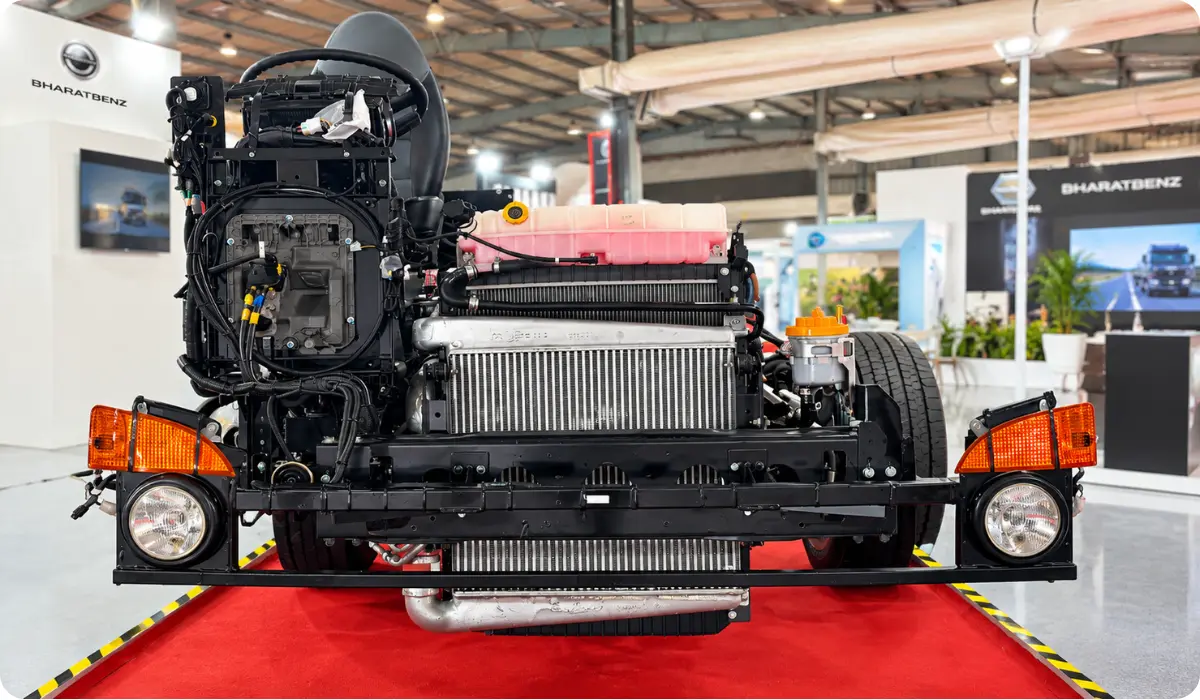
Daimler India Commercial Vehicles (DICV) has unveiled the BharatBenz TorqShift 1926 Heavy-Duty Bus Chassis at Prawaas 5.0, bringing automated manual transmission (AMT) technology to its heavy-duty passenger vehicle portfolio in India.
The new chassis has been developed for intercity and staff transport applications, particularly routes of up to around 500 km. BharatBenz is positioning it around three operator priorities: reduced driver fatigue, improved fuel efficiency and lower operating costs.
AMT Comes to BharatBenz’s Heavy-Duty Bus Chassis
At the centre of the TorqShift 1926 is a globally proven AMT system paired with a 260 hp engine. The automated transmission takes over repeated clutch and gear-shifting operations, allowing the driver to concentrate more on vehicle control and the road, particularly during long intercity journeys.
BharatBenz says the system automatically selects the appropriate gear according to driving conditions. The chassis also gets multiple drive modes, giving operators and drivers greater control over how the vehicle performs in different operating conditions.
BharatBenz TorqShift 1926: Key Features
| Feature | TorqShift 1926 |
| Vehicle type | Heavy-duty bus chassis |
| Primary applications | Intercity and staff transport |
| Transmission | TorqShift AMT |
| Engine power | 260 hp |
| Target route length | Up to 500 km |
| Drive modes | Multiple |
| Eco feature | Intelligent Eco Roll |
| Safety | TPMS with temperature monitoring |
| Auxiliary braking | 5-stage electromagnetic retarder |
| Suspension | Indigenous glide air suspension |
| Other features | Cruise control, hill-start assist |
The above features are those disclosed by BharatBenz for the Prawaas 5.0 launch.
Designed Around Long-Distance Driver Work
The TorqShift 1926’s AMT is particularly relevant to long-distance bus operations because it removes the need for continuous manual clutch and gear operation.
BharatBenz says this can help reduce driver fatigue while supporting more consistent driving and fuel-efficient operation. The company has also included Intelligent Eco Roll, which allows the vehicle to coast more efficiently when conditions permit.
The chassis also features cruise control and hill-start assist, adding to the driver-support package.
For operators running intercity services, these features matter because the economics of a bus are not determined by the chassis price alone. Driver utilisation, fuel consumption, maintenance and vehicle uptime all contribute to lifecycle costs.
Safety Goes Beyond the Braking System
BharatBenz has equipped the TorqShift 1926 with an intelligent Tyre Pressure Monitoring System (TPMS) that also monitors tyre temperature. This provides the driver with real-time information that can help identify abnormal tyre conditions during operation.
The chassis also gets a five-stage electromagnetic retarder, providing additional braking assistance on long-distance routes.
An indigenous glide air suspension system is another important feature, with BharatBenz positioning it as part of the chassis’ ride and operating package.
A Chassis, Not a Fully Built Coach
The TorqShift 1926 is a bus chassis, meaning the final passenger body can be developed by an approved bus body builder according to the operator’s application and requirements.
That makes the product particularly relevant to India’s coach-building ecosystem. Operators can potentially use the platform for different intercity and staff-transport body configurations rather than being restricted to one factory-built body design.
At Prawaas 5.0, BharatBenz also introduced the 917, an 8-metre fully built bus aimed at school and staff transportation, giving the company products at two different ends of the passenger transport market.
What the TorqShift 1926 Means for Operators
The TorqShift 1926 represents BharatBenz’s move to bring automated transmission technology into a heavy-duty bus chassis specifically for Indian intercity operations.
The combination of AMT, a 260 hp engine, driver-assistance features, tyre monitoring, air suspension and electromagnetic retardation gives the chassis a package aimed at reducing the physical demands of long-distance driving while improving operating efficiency.
For India’s private bus and staff-transport operators, the more important test will ultimately be how the AMT technology performs under real-world loads, routes and duty cycles.
Catch the latest Bus Industry updates, Exclusive Interviews, Bus News, and International Bus News on Coach Builders India. Download the latest issue of the The Bus Insider magazine for more insights.