Jagan Automobiles at 60: Six Decades of Building Buses From an Operator’s Perspective

In India’s bus body manufacturing industry, experience is usually measured in years of production, manufacturing capacity, technology, certifications and the number of buses delivered.
Jagan Automobiles looks at experience differently. For the Delhi-based company, some of its most valuable engineering lessons were learned long before it became a full-fledged bus body manufacturer. They came from operating buses, repairing them, maintaining them and understanding what happens to a vehicle once it leaves the factory and spends years on Indian roads.
That distinction has shaped Jagan Automobiles for more than six decades.
Founded by Late Shri Ganesh Dutt Gupta in the 1960s, Jagan Automobiles Manufacturing Pvt. Ltd. began its journey as a transport operator. Its early years were spent running and maintaining its own fleet, giving the company an unusual perspective on passenger transport.
It saw first-hand how buses behave in real operating conditions. It understood where maintenance becomes difficult, how structural fatigue develops, what operators expect from a vehicle and how seemingly small engineering decisions can influence reliability over thousands of kilometres.
Eventually, those lessons moved from the fleet into the factory.
The company transitioned into bus body manufacturing with a philosophy that remains central to its operations today: a bus should not simply look good when it leaves the manufacturing facility. It should be engineered to work reliably throughout its operational life.
That operator’s perspective continues to influence how Jagan Automobiles approaches bus body design, material selection, manufacturing, safety and after-sales requirements.
From Transport Operations to Coach Building
Jagan Automobiles’ evolution closely mirrors several important phases in the development of India’s bus body manufacturing industry.
Its entry into full-scale bus body fabrication came in 1984, when the company played a major role in restoring buses damaged during the riots following the assassination of Prime Minister Indira Gandhi.
The restoration programme presented a demanding engineering challenge. It also demonstrated the company’s ability to work at scale and execute complex bus body fabrication projects.
For Jagan Automobiles, it became an important turning point.
The company was no longer simply operating and maintaining buses. It was beginning to build them. Innovation soon became an important part of that journey.
In 1988, Jagan Automobiles designed and fabricated a completely glass-bodied bus for Maharishi Ayurveda. At a time when conventional bus construction dominated the market, the project demonstrated the company’s willingness to experiment with materials, design and customised vehicle concepts.
Another important milestone came in 1993 when Pankaj Gupta joined the family business after completing specialised training in bus body fabrication at Ashok Leyland’s Chennai facility.
His entry brought additional technical knowledge and modern manufacturing practices into the organisation, strengthening its engineering capabilities and helping the company move further into organised coach building.
Innovation Shaped by Real-World Requirements
Over the following decades, Jagan Automobiles continued to work across changing requirements in India’s passenger transport market.
The company became the first coach builder in the Delhi-NCR region to fabricate a CNG bus body and successfully engineered bodies on some of India’s early semi-low-floor chassis.
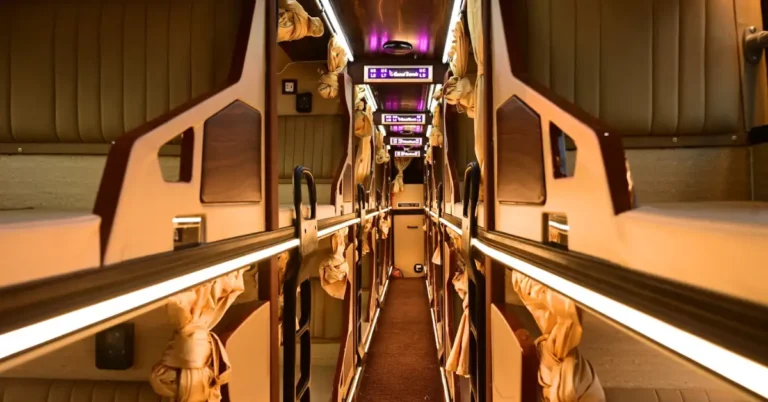
It was also among the early manufacturers in North India to introduce sleeper coaches, at a time when sleeper buses were beginning to emerge as an important format for long-distance passenger travel.
But the company’s work was not limited to conventional passenger buses.
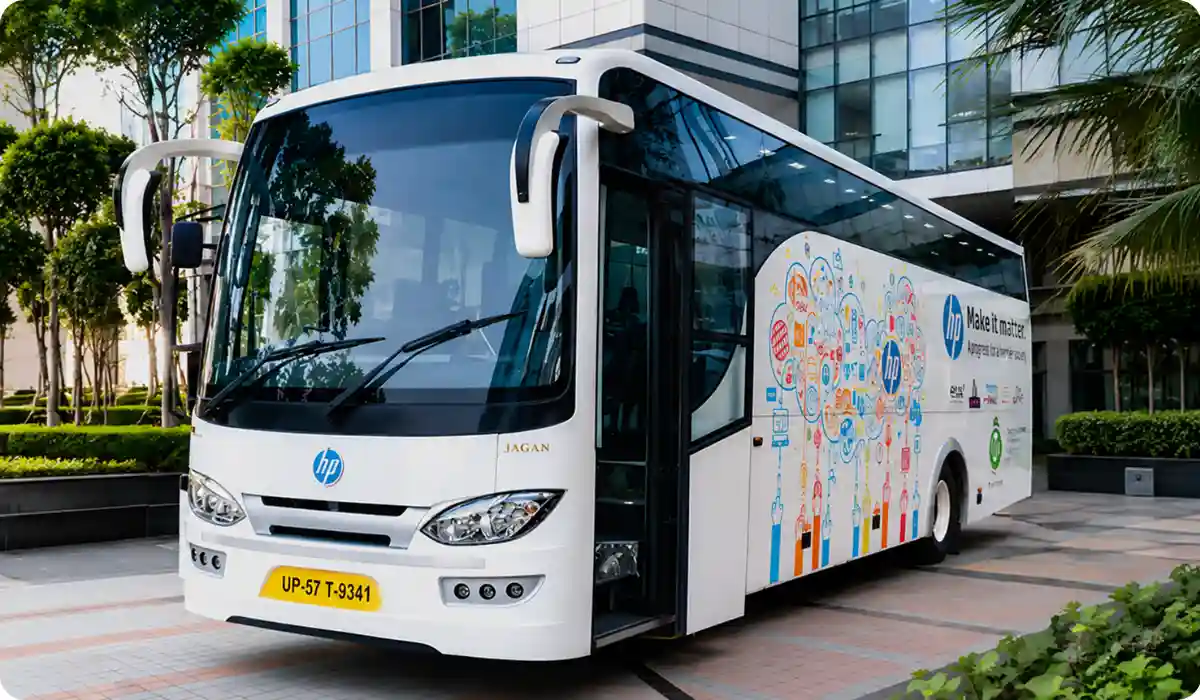
Jagan Automobiles developed a range of specialised mobility solutions, including mobile medical units, mobile classrooms, motor homes, vanity vans and portable corporate lounges for leading organisations across the country.
That diversity is significant.
Special-purpose vehicles demand a different approach to engineering because the body has to be designed around a specific operational requirement rather than a standard passenger configuration. The experience gained across these projects has contributed to the company’s broader understanding of vehicle design and customisation.
The result is an approach where the bus body is treated as an engineered system rather than simply an exterior structure mounted on a chassis.
Building With an Operator’s Perspective
Today, Jagan Automobiles manufactures tourist buses, sleeper coaches, staff transportation buses, school buses and specialised vehicles, while strengthening its presence in tourist and commercial bus segments.
The company’s approach remains rooted in understanding how the vehicle will be used.
A bus designed for long-distance tourism has different requirements from a staff transportation vehicle. A sleeper coach presents different challenges from a school bus. Specialised vehicles demand another layer of customisation altogether.
For Jagan Automobiles, the starting point is therefore not simply the body design. It is the operating requirement.
“Unlike many manufacturers, our engineering philosophy is deeply rooted in operational experience. Having spent decades operating buses, we understand how vehicles perform beyond the factory floor. This perspective influences everything from structural design and material selection to ease of maintenance and lifecycle reliability.”
Pankaj Gupta, CEO, Jagan Automobiles
This philosophy also influences the company’s approach to manufacturing.
For an operator, the value of a bus is ultimately determined by how effectively it performs in service. Downtime affects revenue. Maintenance affects operating costs. Passenger comfort influences customer experience. Reliability affects the economics of the entire fleet.
That makes manufacturing consistency and timely delivery critical.
Jagan Automobiles has therefore focused on disciplined production planning and execution, recognising that a delayed vehicle can translate directly into lost operating revenue for a fleet owner.
AIS 153 Adds Another Layer of Engineering Discipline
The company’s recent achievement of AIS 153 certification represents another important stage in its evolution.
The certification covers multiple seating configurations across chassis platforms from leading OEMs, including Ashok Leyland, Tata Motors, Eicher and BharatBenz, with wheelbases ranging from 4,200 mm to 7,000 mm.
For a bus body builder, AIS 153 represents more than another certification on the company’s credentials. It brings greater emphasis on engineering validation, structural integrity, passenger safety and compliance with defined requirements for bus body construction.
For Jagan Automobiles, the certification is therefore being viewed as an extension of an engineering philosophy developed over decades.
“For us, AIS 153 is not merely a compliance requirement but a reflection of our commitment to delivering products that meet the highest industry standards while ensuring passenger safety and operator confidence,” says Pankaj Gupta.
The development is also significant in the wider context of India’s bus body manufacturing industry.
As safety regulations become more structured and passenger expectations continue to rise, bus body builders are increasingly required to combine fabrication expertise with engineering, validation and compliance capabilities.
The traditional role of the body builder is changing.
The Next Generation Takes the Wheel
The next phase of Jagan Automobiles’ journey is also taking shape through a generational transition.
Er. Yash Gupta, Director and fourth-generation leader, brings an engineering perspective to the family business while carrying forward the principles established over the company’s six-decade history.
That balance between continuity and change could become increasingly important as the Indian bus industry enters a period of rapid transformation.
Passenger expectations are changing. Premium intercity travel is expanding. Safety requirements are becoming more demanding. Operators are looking more closely at lifecycle economics, reliability and maintenance. At the same time, new propulsion technologies and evolving vehicle platforms are creating fresh opportunities for bus body manufacturers.
For companies operating in this environment, manufacturing capacity alone may not be enough.
Engineering capability, regulatory knowledge, manufacturing consistency and an understanding of operator requirements will increasingly determine how effectively a bus body builder can respond to the market.
Jagan Automobiles is continuing to invest in manufacturing infrastructure, advanced fabrication technologies, automation and expanded production capacity as it prepares for this next phase.
Its focus remains on strengthening its presence across tourist buses, commercial buses and specialised mobility solutions.
But the underlying philosophy has not changed.
Experience That Goes Beyond the Factory Floor
There is a certain irony in Jagan Automobiles’ journey. The company’s bus-building philosophy was shaped not by building buses first, but by operating them.
That experience created an understanding of the vehicle that goes beyond the factory floor. It meant knowing what happens when a bus is driven every day, loaded with passengers, maintained under pressure and expected to generate revenue consistently.
Six decades later, that perspective remains one of the company’s defining characteristics.
“For us, quality will always outweigh quantity. We would rather build fewer buses that stand the test of time than more buses that compromise on reliability. Every bus we deliver carries our name – and with it, our commitment to engineering excellence and customer trust.”
Yash Gupta, Director, Jagan Automobiles
For Jagan Automobiles, the next chapter may involve new technologies, new vehicle platforms and changing customer expectations. But the fundamental question remains the same as it was when the company first began operating buses: how do you build a vehicle that works reliably in the real world? After six decades, that experience continues to shape the answer.
Catch the latest Bus Industry updates, Exclusive Interviews, Bus News, and International Bus News on Coach Builders India. Download the latest issue of the The Bus Insider magazine for more insights.